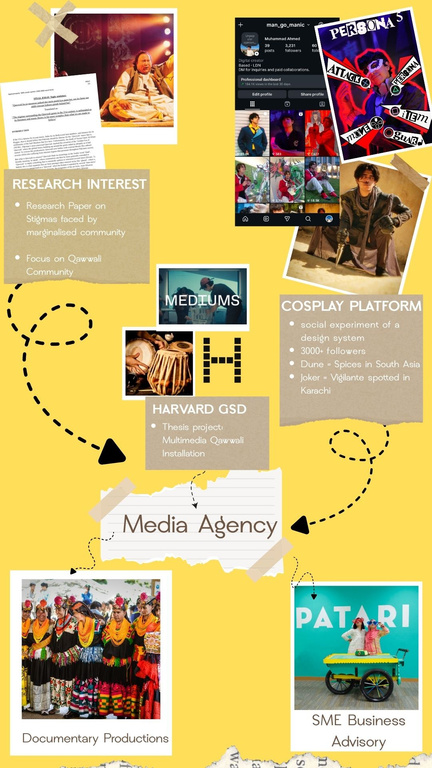
Research Interest
- Research Paper on Stigmas faced by marginalised community
- Focus on Qawwal Community

Front Page
The concept behind this portfolio is A Newspaper from the Future’
Given my ambition, to start a media agency that redesigns global media infrastructures to be more inclusive of developing countries, this portfolio format imagines a time from the future when this has already happened emphasizing the scale and impact of my media agency.
Mission Statement
"We are a design-led media agency that are committed to addressing socio-economic inequities by delivering inclusive, high-quality content that empowers communities often left out of mainstream narratives"
— CEO Ahmed Adeel
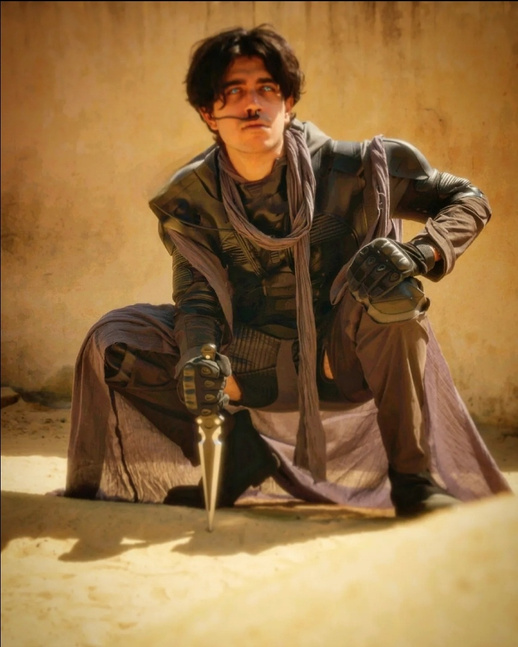
By reimagining Dune from a South Asian perspective, I step into the role of Paul Atreides, embodying the figure of 'Lisan al-Gaib'. I particularly resonated retelling the tale of this character because his story -a tale of colonization and resistance- hits close to my ancestral roots. Though this was shot in a playground, the sand is meant to represent the spices found in Pakistan, whilst the blue eyes are emblematic of some of the distinct features of mountain tribes such as the Kalash tribe in Pakistan.
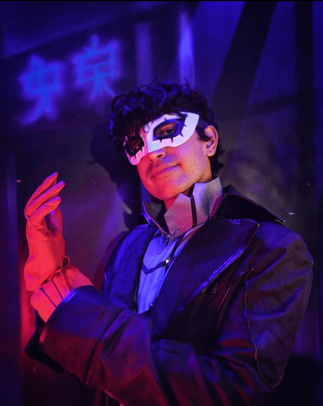
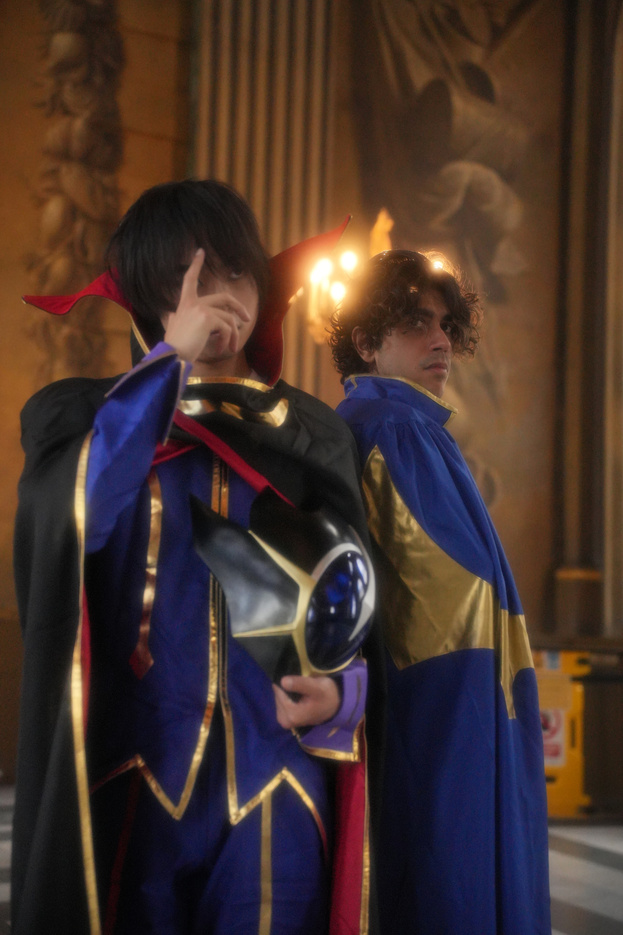
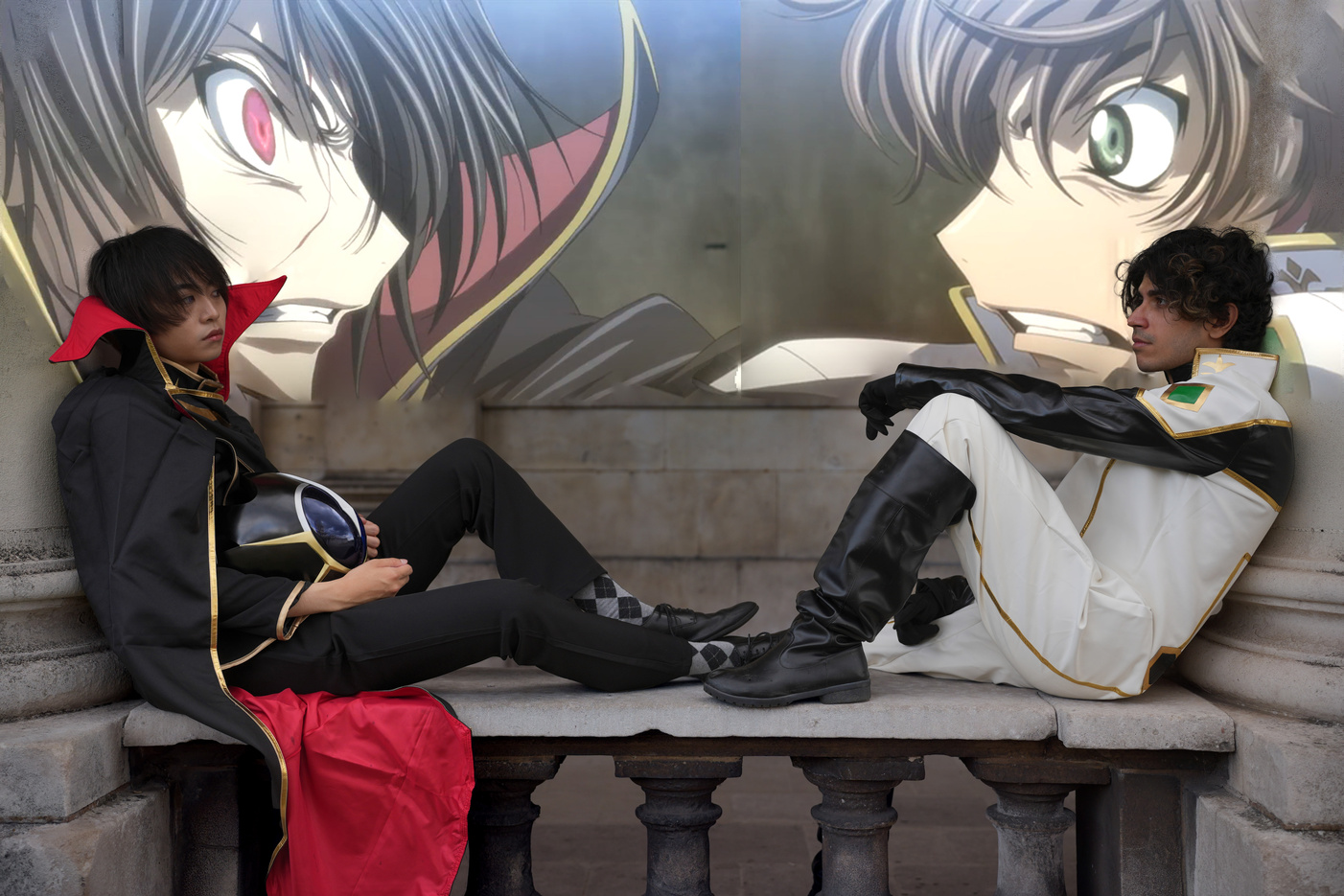
Synopsis: Cosplaying as a masked vigilante from the popular franchise Persona 5 (Atlus Games), this is my version of 'Joker' the Leader of the Phantom Thieves. In this short film, I recreate the video game's cutscenes, showing my change from 'base form' to my transformed alter ego. To edit, I used After Effects and Photoshop to recreate the moody art style and renegade aesthetic.
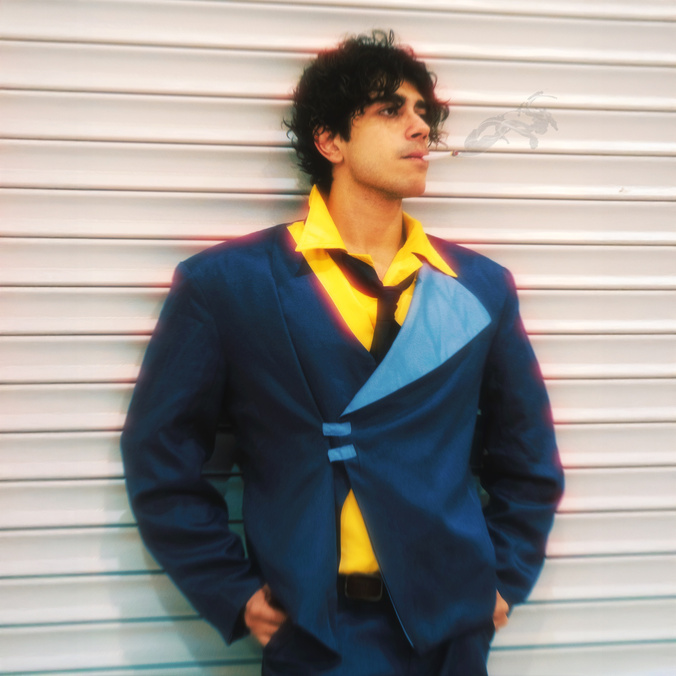
Synopsis: Shifting to graphic design, I used Photoshop to craft a movie poster that reimagines the 90s classic, Cowboy Bebop. Rather than drawing from contemporary icons like Joker or Western films like Dune, the poster embraces a retro-aesthetic inspired by Japan's cinematic culture in 1998.




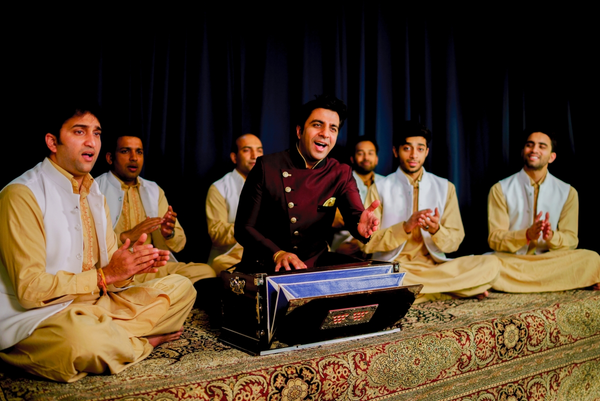
Below is a research paper I wrote on the Qawwal community highlighting the stigmas this marginalized community faces in Pakistan
“The stigmas surrounding the Qawwali genre in the 21st century is unfounded as its literature and music theory is far more complex than what we are made to believe”
If the US is famous for its pop music, India for its Bollywood item numbers, and Jamaica for its Reggae, then it should follow that Pakistan should be famous for the ‘Qawwali’ music that is emblematic of the Sufi Muslims that live here. Unfortunately, the death of Nusrat Fateh Ali Khan (NFAK) –Pakistan’s most renowned Qawwal- marked the cessation of the ‘Golden Era of Qawwali’ where the global frenzy building up around the genre ended as abruptly as it had started. To worsen this predicament, Qawwali now battles with external threats like cultural erosion whilst also suffering from internal stigmas that permeate throughout Pakistani society.
But what is Qawwali in essence? Qawwali finds its etymology in the Arabic word ‘Qaul’, literally meaning ‘to speak’, whose connotation can then be more generally extended to ‘Qawwali’ to imply something that is repeatedly spoken or reiterated several times (Siwani, 1). Indeed, this is what separates this art form amongst other musical styles like ‘ghazal’, where a performance is categorized as a ‘Qawwali’ when the Kalam is repeated by several ‘ham-nawa’ who sing in conjunction to a soloist. Initially, the progenitor of the art form, Amir Khusrau (1252-1325), intended the art form to express the love for his ‘pir’ (teacher), Khwaja Nizamuddin Auliya.
Later on, the genre developed three, more general themes: praising Allah directly (Hamd), the Prophet Muhammad (PBUH) (Na’t) and or other saints or Muslim teachers with close association to the Prophet (Manqabat). The ultimate purpose of Qawwali, however, is to transport listeners into a state of ‘Hal’ (spiritual ecstacy) through union with Allah, and this is done through the synergies of music and spiritual Kalam working together to mesmerize the audience.
Sadly, the genre has been tainted by many stigmas that have dubious credibility at best and ultimately seek to belittle its cultural value. Now, when a layman pictures a Qawwal, what comes to mind is the image of a corpulent, brown man, whose lips and teeth are stained maroon-red with ‘paan’ or ‘gutka’. This is compounded by the violent convulsions and shrieking that may sound hysterical to unseasoned listeners. Although there may be partial semblance of this mental image to reality, the socio-economic value tag branded upon Qawwali is far more problematic. In Pakistan the entire musical vocation is maligned as cognitive biases lead us to automatically presume that Qawwals belong to a lesser background and are impecunious - perhaps even wasting away their life, struggling to make ends meet.
These conceptions are mostly (if not completely) false and the purpose of this essay is to purge the classist and narrow mindset that stains the Qawwali genre. This essay will first establish the four most pressing stigmas discussing the origins of each, in turn.
In order to understand the roots of this particular stigma, there needs to be a solid gasp of where this ‘Gora Complex’ stems from. The reality is that there is a “sense of inferiority — generated by centuries of colonialism…a broken mentality that we are so far behind the West…” (Zaman) that in order to catch up to them we have to become like them. This is perhaps why, most Pakistani’s especially coming from classist backgrounds would rather listen to American pop tunes than Qawwali and dawn on Western couture rather than their own traditional ‘Shalwar Kameez’.
The reality is that Western songs are essentially played on octatonic scales, however, despite the vast level of creative possibilities this allows artists, most of them stick to the comfortable ‘1-4-5-1’ chord progression and use simplistic rhythms simply because they are more lucrative. Even professional music analysts and researchers have “measured the variety of words, chord variations and volume of songs across the decades...they found that… Since the 1950s, vocal timbre — the character of the voice — has become less diverse and pitch content has become totally monochromatic…while everything has gotten much louder overall” (Sloan). To put simply, pop tunes like ‘Old Town Road’ (2019, Lil Nas X) or hits like ‘Baby’ (2010, Justin Bieber) may be superior in terms of streaming statistics, however, are musically far more primitive and melodically simpler than a Qawwali performance.
In comparison, Qawwali music theory is riddled with complexity since it “draws from the same pool of melodic frameworks (ragas) and metric patterns (talas) as classical music” (Gorlinski, 2). A Qawwali performance uses these Raags in the ‘Aalap’ (instrumental improvisation) at the start of the performance. Typical instruments involved could include the harmonium, bansuri, sitar, Dholak, Rubab, sarangi and occasionally even western instruments like the guitar or piano. This is usually accompanied by solmization also called ‘sargam’ or ‘raag batana’ where the vocables “Sa Re Ga Ma Pa Dha Ni Sa”, contrary to popular belief, are not just random ‘shrieking sounds’, but a deliberate and melodically tuned vocal attack.
The main Qawwal will now start to extemporaneously recite lyrics from canon that has been passed down in his gharana (artistic lineage) for generations. If some of these Misra’s (verses) are too complex, the Qawwal may engage in ‘bol samjhana’ which is live interaction and “explanations about the material that was being delivered” ("KARACHI: Homage Paid...").
However, a Qawwali is complete once the vocal orchestra of ‘ham-nawa’ (accompanying singers) chime in and vocally harmonize with the lead singer. To add to this complexity, the main melody can be amplified through musical embellishments such as Murki’s (vibrato), Paltay (melodic turns) and Phailao (spread out belting) for tonal emphasis. Keeping all of these constituents in check is no easy feat, and requires far more musical proficiency than the pop tunes we hear on the radio.
In Pakistan, Qawwals are not considered very literate or highly educated. Perhaps a reason for this is that most of them are not very fluent in the English language. Unfortunately, there exists a psycho-dimension perpetuated by the ruling elite where the English language has been immortalized as “key to power and employment within the private sector” (Rahman) such that anyone who does not have a masterful command over this Western language is automatically deemed uneducated or from a less fortunate background. This has in fact manifested into a linguistic hierarchy where language defines one’s socio-economic standing: the elite are identified by their command over English, the working class are more comfortable in Urdu and the lower class or less fortunate speak their indigenous provincial tongues. (Siraiki, Pashto etc.) For many, this hierarchy is so deeply entrenched as a cognitive bias that since Qawwals almost never learn English (since their occupation doesn’t require it) people assume they are illiterate and have a ‘lesser stature’ in society.
Surprisingly, Qawwals like Aziz Mian are more literate than an average Oxford graduate: having gone on to complete a triplicate Masters where “In 1963, he joined the Punjab University from where he bagged a master’s degree in Urdu literature…Arabic and Persian” (Paracha). To put this into perspective, despite being more internationally acclaimed, Western pop stars like Justin Bieber have not yet acquired even a Bachelor’s degree yet alone three Masters specializations and are still presumably more ‘literate’ than Aziz Mian simply because they can speak English more fluently.
The relevance of Aziz Mian’s linguistic proficiency can be seen through the sophistication of the Qawwali Kalam. Since ‘Gira’s’ (literary knots) tie in poetry from the entire South Asian Diaspora, a “traditional Qawwal will still start their performance with a Farsi invocation, moving on to…Panjabi and moving further eastwards with Hindi, Urdu and Purbi” (Nayyar). In fact, there can even be insertions of Siraiki, Sindhi, Gujarati and Arabic where the genius of the performer lies in his ability to select and lyrically ‘remix’ verses in different languages by stringing them together in terms of relevance to the theme of the Qawwali being performed. Pop singers usually stick to English as their comfort-zone, but a Qawwal must be both a polyglot and a ‘literary surgeon’ where every word he weaves is intentional meditated and purposeful. In this way “a single meaning can be carried across from one language to another” (Qureshi) and a Qawwal is able to relay his message to his audience regardless of their linguistic proliferation.
Another common misconception about Qawwali’s literature is that the constant repetition perhaps reflects on a paucity of lyrical content and philosophical meaning. The reality could not be more converse: A Qawwal repeats the Kalam because it is so rich in meaning such that the obvious nor hidden content may not be apparent the firsttime round. Hence by “repeating a sentence until all meaning is exhausted… brings the audience close to the elusive ma’rifat (knowledge not gained by ordinary means)” (Nayyar). In the example of the ‘Qawwali ‘Allah Hu’, the purpose of repeating Allah (zikr) is to venerate all the meanings of his ninety-nine names.
This third stigma, is not so much as fictitious as it is deceptive. As a devotional form of singing, Qawwali finds its origins in the more liberal, ‘Sufi’ sect of Islam. Sufism itself was formed as a counter process to the orthodox Sunnism in the medieval era where: “Sufis were mystics who opposed the vulgar display of wealth and power in public life by the ulema… Many began to live a retired ascetic life…Thus poverty became strongly associated with the Sufi way of life” (Alam and Bhattacharjee). Sufi’s and Qawwals are not poor out of circumstance but rather out of volition; they prefer a minimalistic and frugal way of life as it keeps them grounded from worldly evils, focusing their devotions on the divine. As proof of this, one can ponder why a superstar like Amjad Sabri did not choose to live in a mansion despite his affluence and commercial success. Instead, when Sabri was asked why he continued to live in his “very humble Liaquatabad residence: the house his father had made for the family…He smiled… and said, “Abba ji visits me here. I cannot leave this house no matter what.” (Raj) This humbleness and modesty pervade even gargantuan personalities like Abida Parveen and NFAK who are not interested in material wealth but reinvesting their wealth into their respective communities.
To further provide credence to Qawwali being a lucrative occupation, one can consider far extremes like Nusrat Fateh Ali Khan who have a massive net worth of “$14 Million” (Ford). On the more pragmatic end of the spectrum, streaming platforms like YouTube allow even young upstart Qawwals like Zain and Zohaib Ali to earn approximately $30,000 for one of their videos that reached 7.5 million views on Nescafe’s YouTube Channel. (“YouTube Views to Money Calculator”). Besides the commission of a performance, another source of revenue is through “Vel… the showering of money on the Qawwal during a performance” (Nayyar) where the amount given in “the vel is always over and above the performance fee of the Qawwal” (ibid.). As such, it can be said with reasonable confidence that any well-trained Qawwal would be paid well for their services, however, choosing not to indulge in extravagance is an entirely separate matter.
As for physical appearance, there is some positive correlation between bulky physique and the notoriety of male Qawwals such as NFAK, Sabri Brothers, and Badar Mian Daad amongst several others. Although, there isn’t any substantial evidence on whether this is pure coincidence or a favorable, physical adaptation, researchers do suggest that “when your bones are larger, you have more space to expand your lung capacity. You can take in more air, which results in a stronger singing voice.” (Reed) However, that said, renowned Qawwals with light physiques and emaciated frames like Habib Painter and Munshi Raziuddin also exist, so being large and corpulent is not a necessary precondition for the profession.
There is also contention with the second part of this stigma: Qawwals aren’t always men. Albeit, originally, Qawwali involved the performing of a “group of male musicians called Qawwals… to a traditionally male assembly of devotees” (Gorlinski, 1) and women were generally marginalized from participating. However, since the commercialization of the art form we have seen an element of flexibility dissolve this male exclusivity.
There are many notable female Qawwals such as Abida Parveen, Reshma and Shakeela Bano Bhopali, all of whom, despite their tumultuous rise to stardom in a male-dominated field: have made an unmistakable impression on the genre. Despite the drought of female representation, performers like Abida Parveen are known to have even outperformed male contemporaries at the ‘muqabala’s’ (competitions) that would take place at U’rs’ (death ceremony of Muslim saints). With the dawn of the 21st century, there has been an increase of female agency in the genre which is encouraging to see; in particular, the rise of notable female Qawwals like the Nooran sisters, Tahseen Sakina and Hadiqa Kiani who led their party of Ham-nawa. Although “women still find themselves on the fringes of Qawwali culture” (Rajan) it is still a significant improvement from the complete segregation women faced when Qawwali was confined to the dargahs.
As can be seen, Qawwali is the yarn that is intertwined and riddled with complexity and these stigmas continue to bind and hide away the potential, joy and power that Qawwali has to offer. To put into context how problematic these stigmas are, one has to consider the fact that even an established Qawwal like Fateh Ali Khan “did not want his son to follow in his footsteps, as being a Qawwal is considered a low-status occupation in Pakistan. Instead, he encouraged young Khan to become a physician”. (Soni) By constructing the horrifying counterfactual of a world without the legend of NFAK (had he been intimidated by these stigmas) one can see how truly dangerous and poisonous they are, especially for the newer generations. There is also the threat of the Salafi onslaught and the grim reality that “in Pakistan, Sufism and its musical traditions are under attack. An assassin murdered one of Nusrat’s contemporaries, Amjad Sabri” (Buntz) and there is imminent danger of this cultural genre being oppressed further.
Given all these problems, this essay would suggest corrective steps that require us to filter for our biases and work to rebuild Qawwali’s reputation. Firstly, it is no secret that Pakistan is a “fledgling nation state with a weak national identity and fragmented multi-ethnic population” (Soni). What Pakistan needs is a strong sense of nationalism and rekindling of our cultural ethos which can only begin to grow if we let go of our ‘Gora Complex’.
Seeing positive changes like Americans establishing their own Qawwali groups like ‘Women of Ilahi Sufi’ and ‘Fanna-Fi-Allah’ is just what this nation needs to reinstate its nationalistic fervor.
Secondly, there needs to be a conscious effort from civil society and private individuals to (monetarily) invest in the Qawwali tradition. This is not only important in order to safeguard the Qawwals against threats to their life (as with Amjad Sabri) but during the unprecedented times of pandemic and lockdown, most of them are stranded at home without any source of income given that the ‘live performance’ dynamic is no more. Financial support would help them maintain their tradition and art even during times of social distancing.
Finally, even though “The role of YouTube … offers a new platform for people to upload their productions, and to create social networks… in … Coke Studio (Pakistan), Nescafe Basement (Pakistan) and The Dewarists” (Rajan), Pakistan’s music industry has been monopolized by capitalist entities who pocket most of the profit. There needs to be initiative to establish a proper legally regulated music industry in Pakistan that ensures intellectual property and copyrights are not infringed upon. Though easier said than done, this would encourage more people to adopt the occupation and propel Qawwali to new heights.
To conclude, this essay discussed many of the stigmas surrounding Qawwali and tried to rebrand the image of a voluminous, brown man who is perceived as illiterate, musically primitive and struggling to make ends meet. A Qawwal can be as educated as Aziz Mian, as prosperous and respected as Ustad Nusrat Fateh Ali Khan or as sonically profound as the Sabri Brothers. In fact, a Qawwal may not be a man at all and may take the form of a female Sufi singer the likes of Abida Parveen. Qawwali itself is an ever-evolving genre that was once constrained to the ‘dargahs’ and now has been publicized for global audiences. Undoubtedly it will continue to change, and so will our perception of it as new stigmas get put in place, however, if even one person out there can see its beauty, purity, and complexity for what it is: the essence of Qawwali will never truly die.